
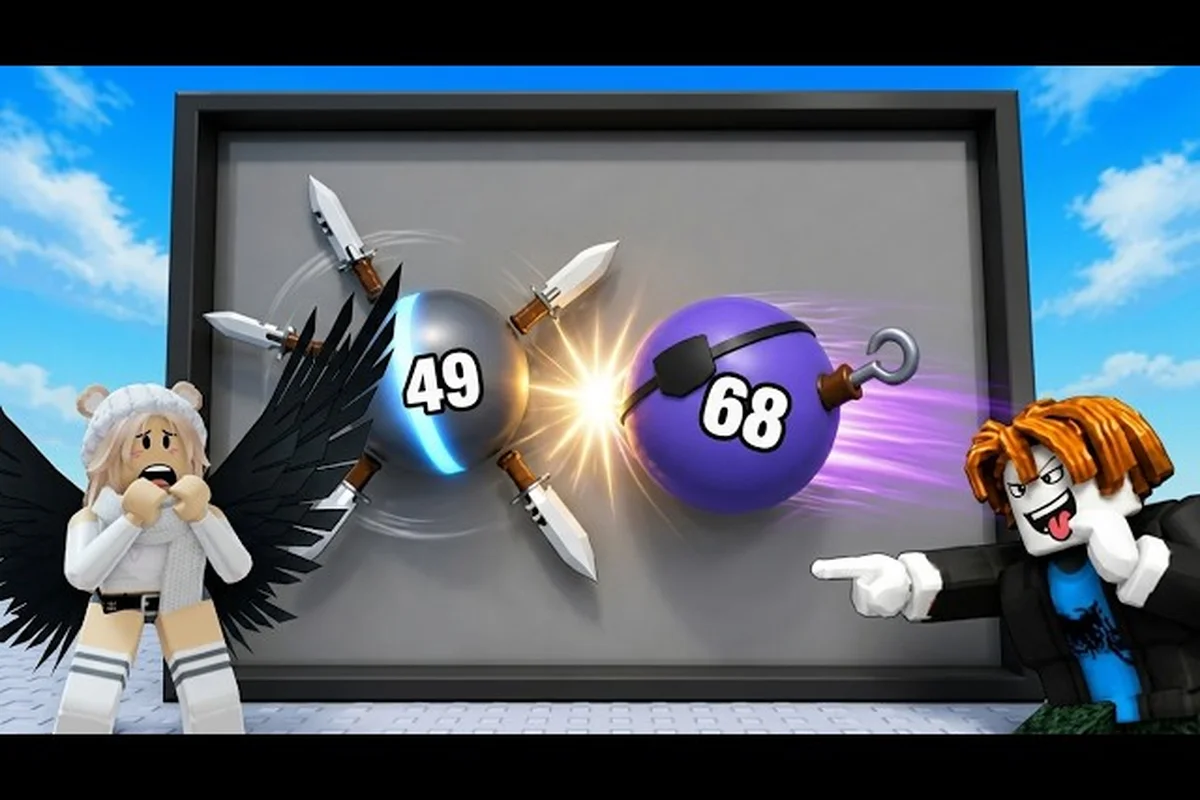
In Ball VS Ball, every arena round is decided in the space between two reads: recognizing the ball your opponent is rolling, and recognizing the direction they are about to swing. This ball vs ball combat guide zeroes in on those two reads, because the official loop on the Ball VS Ball Roblox page is built around them — you pick a ball, you can reroll it mid-battle, and you fight other players for coins. Mastering the read is the fastest path to that payoff.
Reading the Arena Before the First Hit
The most common mistake new players make is treating Ball VS Ball as a pure reaction game. It is actually a recognition game, and the recognition starts before anyone rolls. The arena gives you a small but reliable stream of information: how many players are still alive, the rough shape of the spawn cluster, the angle of the current ball, and the cooldown ring on your reroll. Each of these details constrains what your opponent can do next, which in turn dictates the safest counter.
According to community testing reflected in the high-view ranking video WHICH BALL IS MOST DEADLY? - Tyler & Snowi, the deadliest rounds are rarely the ones where players are mechanically sloppy — they are the rounds where both players are reading the same board and the one who reads it first wins. The community guide Ball VS Ball GUIDE! - CHALLS reinforces the same point, showing that consistent winners tend to pause half a second at the start of every round and inventory the threat surface instead of swinging immediately.
Three Things to Glance at Every Round
Before you commit to a swing, lock in three quick checks. The whole read should take roughly half a second once you have practiced it.
-
Reroll availability — if your reroll is still on cooldown, your current ball is the only one you will have for the next few seconds, so play to its strengths rather than its weaknesses.
-
Spawn cluster — opponents who spawned on your right will tend to swing from the right first because the camera angle favors that side. Mirror that expectation with your dodge.
-
Ring density — if two opponents are still alive and both are within one ring of you, your next action needs to consider both, not just the one you are aiming at.
Mapping the Common Ball Archetypes
Every ball in Ball VS Ball falls into a recognizable archetype, and once you can place a ball in an archetype within a second, the counter almost picks itself. The official game page confirms that balls appear randomly and can be rerolled, which means you will see most archetypes several times per session. The table below summarizes the four archetypes you will encounter most often in ranked play, based on community reports and the developer-product store structure referenced in BALL VS BALL FULL GUIDE! - Clout Brothers.
| Archetype | Typical Behavior | Best Counter Read | Risk if Misread |
|---|---|---|---|
| Charger | Bull rushes in a straight line, high damage on contact | Sidestep at the last quarter of the dash and punish the overshoot | Full HP loss if you hold ground |
| Spinner | Rotates in place, hits anything inside the ring radius | Back off to ring edge, then dart in during the rotation gap | Repeated chip damage if you stand in the ring |
| Zoner | Stays at range, projects arcs or orbs outward | Close the gap on cooldown windows, never walk straight in | Slow HP drain while you wait |
| Brawler | Short swings, fast recovery, likes to trade | Whiff-punish with a longer-reach ball, then disengage | Losing the trade war by small margins |
The archetypes are useful precisely because they are stable: a Spinner behaves like a Spinner regardless of the cosmetic skin, so once you can identify the rotation start, the counter is the same fight in. If you want a deeper breakdown of how to pick your first ball and read the reroll economy, the Ball VS Ball beginner guide covers the onboarding side of that decision in more detail.
Dodging Drills That Actually Transfer
Dodging in Ball VS Ball looks twitchy from the outside, but good dodges are not twitch at all — they are pre-planned. The community consensus, echoed in onboarding walkthroughs like How to Play Ball Vs Ball Roblox - Full Guide - VendoPlus, is that players who dodge on rhythm beat players who dodge on reaction almost every time. The reason is simple: the ball arcs and dashes in Ball VS Ball have visible startup frames, and if you already know the timing window, you can dodge on the beat instead of trying to parse the visual.
A useful mental model is to think of each dodge as having a three-beat structure: a setup beat where you commit to a direction, an execute beat where you break stride, and a recover beat where you reset to neutral. If you only train the execute beat, your dodges will be late and you will get clipped. If you train all three, the dodge becomes a habit you can fire without thinking.
The Three Drills That Build the Habit
These drills are designed to be run in a private server, which the community frequently uses for focused practice because the round timer and the spawn behavior are identical to public play. The third drill in particular is something most ranked players swear by, and it pairs naturally with the team-strategy section further down.
-
Mirror drill — find a partner, agree on a single dodge direction, and alternate attacks. Focus only on your setup beat: where do your feet need to be half a second before the swing lands?
-
Beat drill — solo in a private server, pick one Charger bot, and dodge only on the visual windup. Count the beats out loud. After ten clean dodges, the rhythm will be in your hands.
-
Double-feint drill — in a 1v1 with a partner, swing twice, then cancel the second swing into a dodge. This is the bread-and-butter opener in higher ranks, and it is the move you will see most often when watching top players.
Reading Dodge Cues, Not Dodge Animations
A common trap is to wait for the opponent's dodge animation to start before you react. By then it is too late against a clean player. Instead, watch the pre-dodge cues: a slight weight shift, a brief stutter in their movement, or a camera flick to a new angle. The official game loop lets players reroll mid-battle, and the reroll animation is one of the strongest pre-dodge cues you will see, because most players reroll into a ball whose archetype they want to use as their next move. If you can spot the reroll, you can often predict the next archetype and the counter with it.
Aim Habits That Win Arena Rounds
Aim in Ball VS Ball is split into two layers: arc aim for Zoners and Brawlers with projectiles, and contact aim for Chargers and Brawlers in melee. The mistake players make is to train only one layer. A clean combat player trains both, and switches between them on the same round depending on what ball they currently hold.
The good news is that aim in this game is not about pixel-perfect crosshair placement. It is about choosing the right swing plane for the situation, and that choice is mostly a function of distance and the opponent's last movement. Community data from the ranking video above suggests that players who climb past the mid ranks almost never take the same swing plane twice in a row, because predictable planes are how you give away free HP.
Choosing the Right Swing Plane
Swing plane is a slightly abstract concept in Ball VS Ball, but the practical version is straightforward: at any given distance, there are roughly three viable swing planes you can take. Pick the one the opponent is not currently defending.
| Distance | Swing Plane A | Swing Plane B | Swing Plane C |
|---|---|---|---|
| Close (inside the ring) | Vertical chop | Horizontal swipe | Short jab into recovery |
| Mid (ring edge) | Diagonal arc | Delayed feint into poke | Low sweep |
| Far (outside the ring) | Projectile lead | Curved toss | Strafing poke while closing |
Notice that the mid-distance plane C is essentially a feint, and feints are disproportionately important in Ball VS Ball because the reroll mechanic means a single feint can bait a reroll out of your opponent, which gives you a window where their next ball is fixed. That window is often the cleanest hit you will get all round.
The Three Aim Habits to Drill Every Session
Aim is mostly a habit problem. The mechanics are simple enough that the gap between a mid-rank player and a high-rank player is rarely raw mechanics — it is the consistency of the habits. Drill these three until they feel automatic, and you will close most of that gap without changing a single piece of gear.
-
Lead with the camera, not the swing — your camera angle is your real aim. If you want to throw a curve, point the camera at the curve before you start the swing, not during it.
-
Commit to the plane for one full beat — half-committed swings are the most punished action in the game. Pick the plane, fire the swing, recover, then reassess.
-
Reset to neutral after every clean hit — the player who keeps moving after landing a hit is the player who gets counter-punished. The habit of resetting is what separates a one-hit round from a three-hit round.
If you are still building the fundamentals and want a wider look at how rounds actually flow, the Ball VS Ball how to win page covers the round-by-round decision tree from a different angle and is worth pairing with this drill list.
Counter Reads for the Four Archetypes
Counter reads are the connective tissue between dodging and aiming. A counter read is the moment you recognize the archetype, predict the next move, and pick the dodge-plus-swing combination that punishes it. This is where the combat guide earns its keep, because the counter read is the actual skill ceiling of the game, not the swing or the dodge in isolation.
The best way to train counter reads is to play long enough that each archetype becomes familiar, then play more so that the transitions between archetypes become familiar. The transitions matter because, in a real round, your opponent will reroll, and you will face two or even three archetypes in the same fight. The community call this the archetype carousel, and surviving it is a learned skill rather than a gifted one.
The Counter Read Cheat Sheet
The table below compresses the read-and-counter for the four core archetypes into a single page. It is intentionally short — counter reads are about instinct, not memorization — but the headline action for each archetype is the one you should drill first.
| Opponent Archetype | First Visual Cue | Default Read | Punish Swing |
|---|---|---|---|
| Charger | Windup stomp, straight-line orientation | They will commit to one direction at the start of the dash | Sidestep and swing into their overshoot |
| Spinner | Rotation begins, ring radius visible | They cannot change direction mid-spin | Back off, then poke into the rotation gap |
| Zoner | Camera pulls back, projectile starts charging | They will hold position until the projectile resolves | Strafing close, then punish on the cooldown window |
| Brawler | Short grip animation, fast shuffle step | They will trade, not commit | Whiff-punish, never trade first |
When the Archetype Carousel Spins Twice
The harder version of the counter read is when your opponent rerolls mid-fight. According to the official game page, rerolling is a built-in mechanic, and top players use it as a tempo tool rather than a panic button. The two situations you need to prepare for are reroll into same archetype (which means your read was right and you should keep pressing) and reroll into counter-archetype (which means your read was wrong and you need to back off immediately).
A clean way to handle the carousel is to treat the reroll animation as a free half-second of information. The opponent has just told you that the ball they had was not working. Use that half-second to set up a swing plane you would not otherwise have, and you will catch a meaningful fraction of rerollers leaning into the wrong direction.
Team Strategies and Private Server Tactics
Ball VS Ball is most often played solo, but the team modes and the ability to run a private server with a consistent group change the math substantially. According to community reports, players who queue with a small fixed team climb noticeably faster than players who solo-queue, because team play lets you specialize roles and cover each other's archetype weaknesses.
The two main team strategies that show up repeatedly in higher-rank play are the double-Spinner comp and the Charger-Spinner pivot comp. Both are worth knowing because they teach the underlying principle: in team play, your archetype choice is also a statement about what your teammate should expect to face.
Building a Two-Player Comp
| Role | Archetype | Job in the Round | Best Partner Archetype |
|---|---|---|---|
| Anchor | Zoner or Brawler | Holds the line, punishes overextensions | Charger (for cleanup) |
| Pivoter | Charger or Spinner | Creates openings, applies pressure | Brawler (to hold the line) |
| Flex | Any, decided on reroll | Reads the comp, switches as needed | Either, depending on first read |
The Flex role is the most underrated. In a private server with a regular partner, the flex player is the one who reads the opponent's comp, rerolls into the counter-archetype, and calls the switch. If you are the kind of player who enjoys reading the board rather than committing to a single archetype, flex is your role, and a private server is the best place to practice it.
Private Server Drills for Teams
Private servers are not just for warm-up. They are the cleanest place to drill team-specific reads because you can reset the round instantly and you can run the same scenario ten times in two minutes. The most useful private-server drills, based on community-shared practice routines, are:
-
Mirror comp drill — both players take the same archetype and play a clean 1v1. The point is to feel the rhythm of that archetype when both players are using it, so you can predict mirror matches in public play.
-
Counter comp drill — agree on a comp beforehand, then fight a partner running the counter comp. Rotate every few rounds so each player practices both sides.
-
Carousel drill — the reroll partner switches archetypes every swing, forcing you to read and counter each time. This is the closest simulation to a real ranked round.
-
Anchor-pivot drill — one player holds the line as anchor, the other player pokes and pivots. Swap roles every three rounds.
The carousel drill in particular is worth spending a real session on. Players who drill it report that the public ranked carousel feels noticeably slower afterward, because the simulated version forces you to make a counter read on every swing rather than waiting for a "safe" moment that almost never arrives. For players who want to keep improving beyond the basics, the Ball VS Ball last one standing tips page digs into the survival side of those late rounds, which is where team comps and counter reads compound the most.
Frequently Asked Questions
What is the single most important skill in Ball VS Ball combat?
The single most important skill is the counter read — recognizing the opponent's archetype and predicting their next swing within the first half-second of the round. Mechanics like dodging and aiming matter, but they are downstream of the read, because every swing and dodge you commit to without a read is a guess, and guesses lose rounds against clean players.
How do I practice dodging without burning ranked rating?
The cleanest way is to run a private server with a partner and cycle through the three drills above: the mirror drill, the beat drill, and the double-feint drill. You can also queue against a friend in unranked and focus on one archetype at a time. The community guide video by CHALLS walks through a similar routine and is a good reference for how to structure a twenty-minute practice block.
Which ball archetype is the strongest for solo queue?
There is no permanent answer, because the official reroll mechanic lets you swap mid-battle, and the strongest archetype shifts with each patch. Community reports from the ranking video suggest Chargers and Zoners are the most consistent solo-queue picks right now, but the real skill is being able to play all four archetypes competently so you can flex into whatever the round calls for.
Is it better to play with friends or solo in Ball VS Ball?
Playing with a fixed team is faster to climb with, mostly because the anchor-pivot comp lets you specialize and cover each other's weaknesses. Solo queue is still viable and is the only way to practice reading unfamiliar players, but if you have one or two friends who are willing to run a private server drill block with you, the team comps above will translate directly into ranked gains.
How often should I reroll my ball during a fight?
As a rule of thumb, reroll only when your current ball is losing the matchup or when you have a clear read on the counter-archetype. Panic rerolling is the most common mid-rank mistake, because every reroll is a small window where your next ball is fixed and your opponent can punish the swap. If you are not sure, hold the ball and play the matchup you have.