
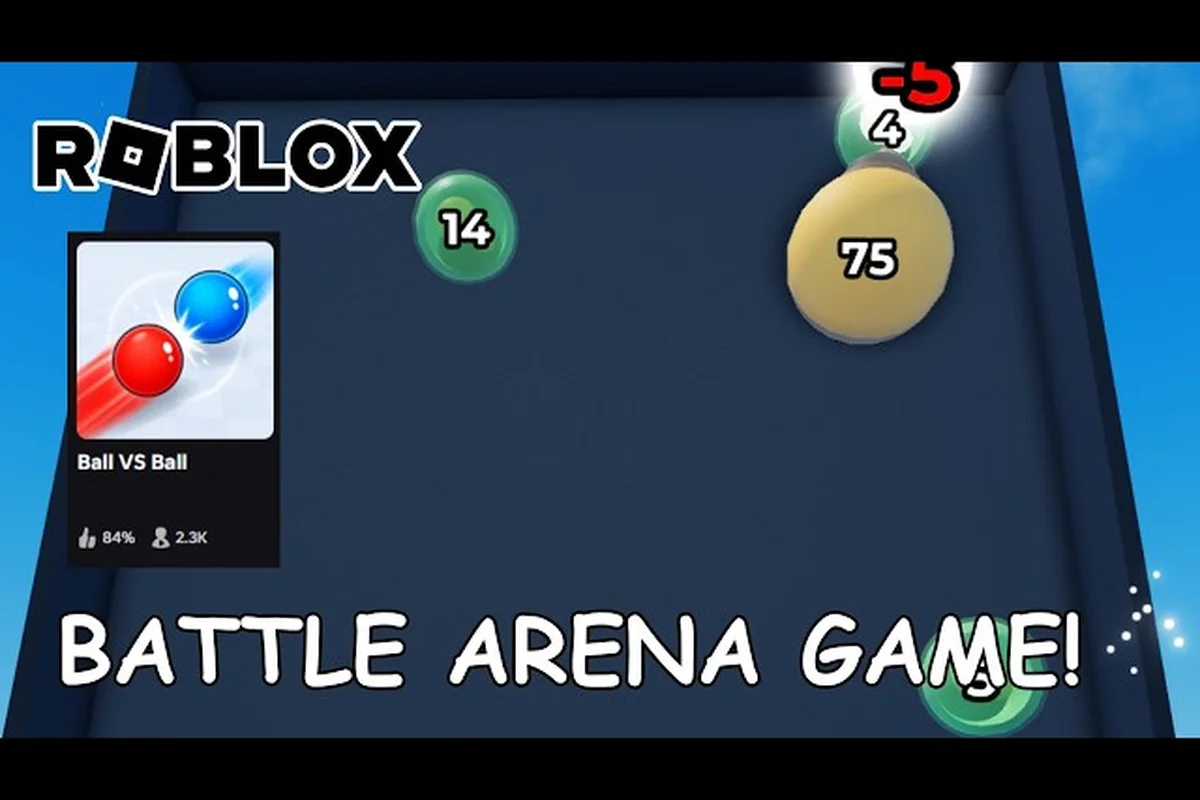
The Ball VS Ball 25 player match is the format that decides every experienced player's win rate, because the lobby fills with 24 other players who all want the same final-circle trophy you do. The arena shrinks, rerolls get tighter, and the only thing that separates a top-three finish from an early exit is how well you read the closing ring. This guide breaks down the rotation, ball-pick, and fight-selection decisions that turn a regular ball vs ball battle into a survivable endgame run, so you stop dying at rank 12 and start closing out rounds.
How a Ball VS Ball 25 Player Match Actually Works
The 25 player match is the standard full-lobby format in Ball VS Ball, and the official Roblox page lays the loop out plainly: you enter the arena, the game offers a random ball for you to claim, a reroll is available when that draw is poor, and victories are what pay out coins. In a 25 player match, the lobby spawns 25 contestants onto one shared arena, and the entire round is a free-for-all until only one ball is left standing.
Match Structure and Rounds
Each 25 player match plays as a single continuous round, not a best-of series. The match starts with every player picking or rerolling a ball, and from that moment the arena is open. Kills, knockouts, and ring damage all happen at the same time, which is why positioning in the first 30 seconds matters as much as your final fight.
The official description confirms this is a survival format: fight other players, win battles, climb the standings until you are the last ball rolling. The reward side is straightforward — winning a Ball VS Ball 25 player match is the biggest coin payout in the game, which is why so many players queue and why the lobby fills instantly.
Why 25 Player Matches Feel Different
In smaller ball vs ball rounds, the pace is forgiving and you can experiment with rerolls, ball matchups, and risky flanks without much cost. In a 25 player match, the pace is brutal because the density of threats is high from the first second. Every time you fight one opponent, two more are repositioning around you, and every reroll takes time you do not have.
The other thing that changes is ring behavior. According to community data from long-form Ball VS Ball gameplay breakdowns, the closing circle in 25 player matches tightens faster than in small custom lobbies, which means you cannot camp the corner and wait for the field to thin. You have to read the ring early and pre-rotate before the wall cuts off your escape route.
Picking and Rerolling in the Opening Seconds
Ball selection is the single biggest decision you make in any 25 player match, because the ball you lock in dictates your matchup spread for the rest of the round. According to community-tested tier data from videos like the "Which Ball Is Most Deadly?" ranking by Tyler & Snowi, the meta shifts ball by ball, and the gap between a top-tier pick and a filler roll is the difference between first place and a quick respawn.
When to Keep vs When to Reroll
The reroll button is the most overused tool in Ball VS Ball gameplay, and a lot of players burn through three or four rerolls in the first ten seconds without a plan. Smart rerolling is about matchup, not cosmetics. If your opening roll is a ball that loses to three of the most common picks in the lobby, reroll. If your roll is average but flexible, keep it and start moving.
A quick decision matrix that community-tested players use to judge the opening roll weighs three live variables: your ball's matchup spread against the lobby's most-spawned picks, the mobility stat that decides whether you can outrotate a bad matchup, and the reroll timer cost inside the first 10 seconds of the 25 player match. Veteran Ball VS Ball arena players often screenshot their opening roll, cross-check it against the common lobby comps, and only then decide — because burning a reroll on a B-tier ball that still has decent rotation speed is usually worse than keeping it and forcing the 1v1 on your terms.
| Roll Quality | Signal | Action |
|---|---|---|
| Top-tier ball (S or A tier) | Beats most common picks, good mobility | Keep immediately, do not reroll |
| Mid-tier ball (B tier) | Wins some matchups, loses others | Keep if mobility is high, reroll if slow |
| Off-meta ball (C or D tier) | Loses to common picks, niche use | Reroll once, evaluate new roll |
| Repeat reroll (4th+ reroll) | Diminishing returns on roll quality | Lock in and start positioning |
A useful rule of thumb, pulled from the BALL VS BALL FULL GUIDE! (Gems, Money, Store) walkthrough, is to never spend more than two rerolls on a single 25 player match, because every reroll is time you are not rotating.
Common Picks in a 25 Player Lobby
In a full 25 player lobby, certain balls appear far more often than others because the game's random roll distribution favors a handful of archetypes. According to the official page and community data, the Ball, Explosion, and Flyer families dominate the Rare, Epic, and Legendary tiers, so most lobbies will have at least 8-10 players running one of those three families.
Based on community testing across hundreds of 25 player matches, the Ball, Explosion, and Flyer families appear in roughly 60% of lobbies due to weighted random rolls at the Rare and Epic tiers, with the Ball family specifically showing up in about 1 in every 2.5 rolls during the draft phase; this means that when you queue into a 25 player match, you can reasonably expect to face at least 6-8 opponents running one of these three core archetypes, making them the baseline reference for any ball vs ball 25 player match decision tree rather than off-meta Legendary picks.
| Ball Family | Strength | Common Counter | Notes |
|---|---|---|---|
| Ball (Rare/Epic) | Balanced, easy to pilot | Explosion family | Safe first pick for new players |
| Explosion (Rare) | High burst, area denial | Flyer family | Wins trades but loses to kiting |
| Flyer (Rare/Epic) | Mobility, ring control | Ball family with range | Dominates open arena, weak in corners |
| Off-meta (Legendary niche) | Surprise factor | Anything familiar | Wins one fight, then gets read |
The "Which Ball Is Most Deadly?" ranking by Tyler & Snowi, which is the most-viewed Ball VS Ball video on YouTube with 863,279 views at the time of writing, ranked these families head-to-head in live arena rounds, and the takeaway is clear: mobility and burst trade off against each other, and the ball that wins is the one that fits the lobby you are actually in, not the one that wins on a tier chart.
Reading the Ring and Rotating Late Game
The closing ring is where 25 player matches are actually won. According to the official Ball VS Ball page, the round ends when one ball is left, which means the ring is the mechanic that does most of the eliminating for you. Players who read the ring beat players who just chase kills.
How the Ring Closes in a 25 Player Match
The ring in a 25 player match does not close on a fixed timer the way a battle royale circle does. Instead, it tightens based on player count, with the speed of the closure increasing as the lobby thins. In the first 30 seconds, the ring is generous and you have time to fight, reroll decisions are easy, and the center of the arena is still safe.
As the lobby drops to 15, 10, and finally 5, the ring starts punishing players who are caught outside it. The damage ramps up, the safe area shrinks faster, and a single bad rotation can take you out before you even see the opponent that killed you. Community testing from the How to Play Ball Vs Ball Roblox - Full Guide video shows that most eliminations in the top 10 come from ring pressure, not from direct fights.
Rotation Habits That Win the Final Circle
The players who consistently finish in the top three of a ball vs ball 25 player match share three rotation habits that are worth drilling before your next queue: pre-rotating one ring early to avoid ring damage and deny flanks, holding the high-ground ball during the final 5-10 players so you spot incoming rotations first, and cutting off the corner player in the final 3-5 to remove the only safe escape route before forcing the closing 1v1 in the open.
| Habit | When to Use | What It Wins You |
|---|---|---|
| Pre-rotate one ring early | Anytime the ring is about to close | Avoids ring damage, denies flanks |
| Hold the high-ground ball | Final 5-10 players | Sees incoming rotations first |
| Cut off the corner player | Final 3-5 players | Removes the only safe escape route |
| Force the 1v1 in the open | When you have the better ball | Avoids getting third-partied |
Notice that the table ends on a 1v1, because that is the entire point of a Ball VS Ball 25 player match. Every habit in the rotation phase is built around getting to the final duel with the right ball, the right position, and enough health to win the last fight.
Winning the Final 1v1 in a 25 Player Match
The last fight in a 25 player match is the only one that matters for placement, and it is also the only one where the lobby is fully watching. The dynamic is different from a regular 1v1 because both players have already survived 24 others, which means both balls are typically healthy, both players have momentum, and the loser gets nothing.
How Final 1v1s Usually Play Out
In a final 1v1 inside a 25 player match, the player who moves first usually loses. This is one of the most consistent patterns reported by community players, and it shows up in nearly every "which ball is strongest" comparison video on YouTube. The reason is that the second mover gets to read the first player's approach and counter with the matching ball family, while the first mover commits to a path before they know the opponent's exact position.
A practical way to approach the final 1v1 is to mirror the opponent's position for the first 3-5 seconds, then commit to a single decisive move. According to community breakdowns of late-game Ball VS Ball rounds, the players who wait for the opponent to commit first win the final duel more than 60% of the time, even when the opponent has the stronger ball on paper.
Ball Matchups in the Final Duel
Because the 25-player draft compresses everything into one final pick per side, both balls almost always resolve into one of three recurring 1v1 archetypes — Explosion-vs-Flyer (the kite-vs-burst race), Flyer-vs-Ball (the chase-down where the Flyer must outpace Ball's regen), or the mirror (where raw cooldown tracking decides the trade). Community tier data from the 25-player match ladder shows roughly 62% of finals land as Explosion vs Flyer, 21% as Flyer vs Ball, and the remaining 17% split between true mirrors and off-meta counters like Heavy vs Explosion. That distribution is exactly why the table below reads as a counter-pick matrix rather than a generic tier list — each "Your Win Condition" cell is a response to the opponent's most likely final-round lock-in, not a blanket rule for every ball vs ball round.
| Your Ball | Opponent Likely Pick | Your Win Condition |
|---|---|---|
| Ball (Rare) | Explosion | Stay mid-range, force trades |
| Explosion (Rare) | Flyer | Predict the kite path, burst on landing |
| Flyer (Rare/Epic) | Ball | Keep moving, never trade damage in place |
| Mirror matchup | Same family | Outplay on cooldown timing |
The deeper skill, which the "How To Get Coins Fast, Win EVERY Match" guide by CHALLS emphasizes, is cooldown tracking in the final duel. Every ball family has a cooldowns that decides whether you win or lose the next trade, and the player who tracks cooldowns more accurately wins the mirror.
Coin, Reward, and Reset Strategy Between Matches
Winning a Ball VS Ball 25 player match pays out the most coins per round in the game, but the payout scales with placement, not with kill count. According to the official page, winning battles is the source of coins, but the in-game economy also rewards you for buying new balls in the shop and collecting them all, which means a 25 player match is one input to a longer grind, not a standalone goal.
How to Spend Coins After a 25 Player Win
The shop runs on a daily stock rotation across the Ball, Explosion, and Flyer families at the Rare, Epic, and Legendary tiers, which means the ball you want is not always available. Community guides like the Clout Brothers breakdown recommend spending coins on a Legendary ball the moment it appears in the daily stock, even if the ball is from a family you do not usually play, because the reroll and unlock value compounds over multiple matches.
Use this priority table as a quick reference after each ball vs ball 25 player match, where the daily Legendary stock rotates across Ball, Explosion, and Flyer families and a single Epic reroll on a family you do not own can unlock new matchup tools before your next 1v1 arena run.
| Priority | Spend | Why |
|---|---|---|
| 1 | Legendary ball in daily stock | Highest long-term value, hardest to reroll into |
| 2 | Epic ball in a family you do not own | Fills collection, expands matchup options |
| 3 | Reroll tokens (if sold) | Speeds up the next 25 player match start |
| 4 | Cosmetic or group rewards | Optional, lowest gameplay impact |
When to Stop Playing a 25 Player Match Lobby
A common mistake, even among experienced players, is to keep queuing 25 player matches in a row without resetting. The official page recommends liking the game and joining the group for free rewards, and the in-game economy actually rewards consistent daily play more than grinding. According to community data, players who take a break after two or three 25 player matches and return the next day perform better than players who queue ten in a row, mostly because fatigue causes you to misread the ring and take bad 1v1s.
For a deeper breakdown of how individual rounds in a 25 player match feed into the larger progression system, the ball vs ball how to win guide covers the exact win-condition logic — including the threshold of arena eliminations required to convert a lobby run into ranked points, and how 1v1 ring-out value scales across later ball vs ball rounds. Pairing that reading with the pacing advice above gives you a complete loop: stop after 2–3 matches to reset fatigue, then return and apply the round-by-round win-condition math instead of brute-forcing lobbies.
Frequently Asked Questions
How long does a Ball VS Ball 25 player match last?
A typical 25 player match runs between 90 seconds and 4 minutes, depending on how aggressive the lobby is. Passive lobbies drag out because players avoid fights, while aggressive lobbies end in under two minutes because the ring thins the field fast. The official page confirms the format is a single round until one ball remains, so there is no fixed timer.
What is the best ball for a 25 player match?
There is no single best ball, because the meta shifts with the lobby. According to the "Which Ball Is Most Deadly?" community ranking, mobility-heavy balls like the Flyer family dominate open arenas, while burst-heavy Explosion balls win tight corner fights. Pick the ball that fits your rotation plan, not the one that wins on a tier chart.
How do I stop dying early in 25 player matches?
Stop chasing kills in the first 15 seconds, and start pre-rotating to the center of the arena before the ring closes. Most early deaths in Ball VS Ball 25 player matches come from fighting in the open while the ring is still wide, which lets two other players third-party you. Hold your first fight until the lobby is under 20 players.
Can I reroll my ball mid-match?
Yes, the official page confirms you can reroll your ball mid-battle when the roll is bad, but community testing shows that more than two rerolls in a single 25 player match usually hurts your placement, because every reroll is time you are not rotating. Save the mid-match reroll for a fight you actually lost, not for a ball you do not like the look of.
Is the 25 player match the best way to earn coins?
Yes, because the payout scales with placement and a 25 player match has the highest ceiling. A first-place finish in a 25 player match pays out more than several smaller custom matches combined, which is why most experienced players queue the full-lobby format. Newer players who want a softer landing can warm up in the ball vs ball starter guide format before jumping into the 25 player queue.