
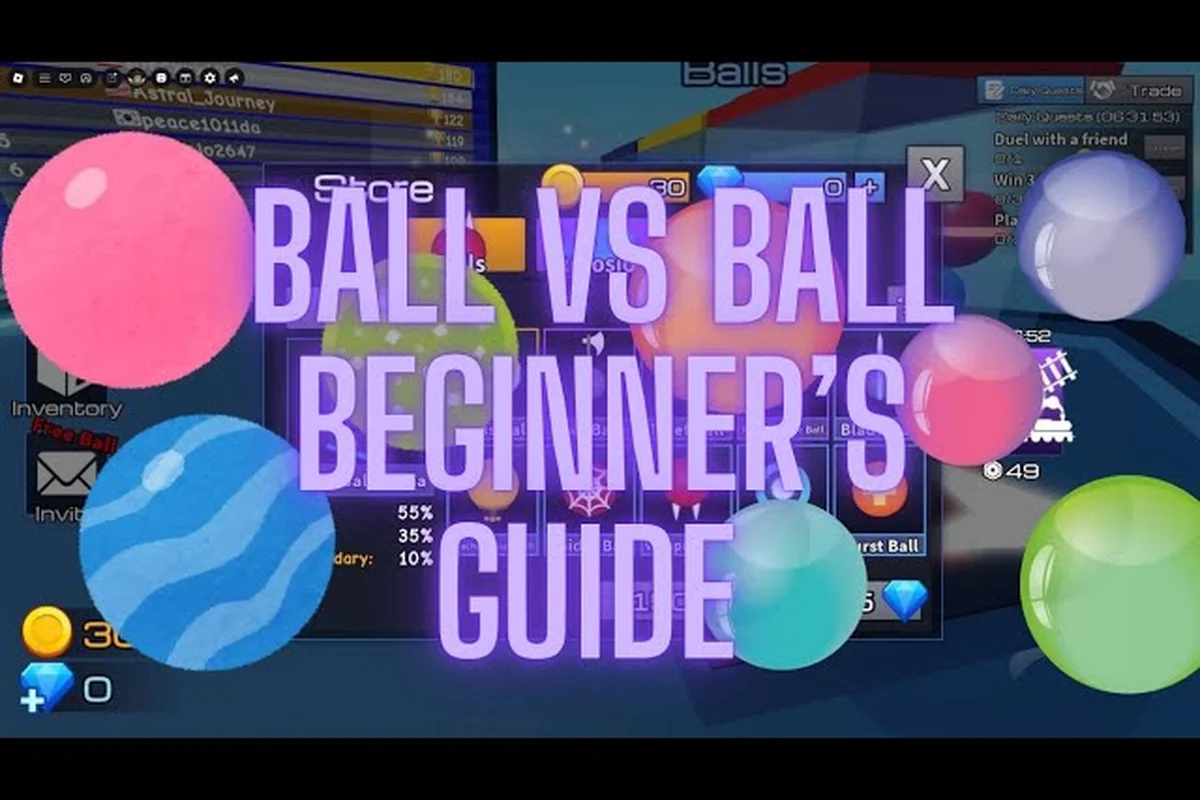
A serious Ball VS Ball ball comparison comes down to three things: raw stats, ability interactions, and how each ball actually plays when another player is trying to delete you. The Roblox arena game drops you into randomized rounds where your sphere is your entire kit, and the difference between a quick topple and a clutch comeback usually traces back to the roll you drew and how well you understood it before the first bounce. This breakdown pulls together everything the community has stress-tested in live matches, from damage output and mobility to the rarer Legendary drops that swing whole lobbies, so you know exactly which sphere deserves the coins you have left.
The balls in Ball VS Ball are split into three families — Ball, Explosion, and Flyer — each appearing at Rare, Epic, and Legendary tiers according to the in-game shop structure. Rather than treating every sphere as a flat list, this comparison groups them by playstyle so you can match a ball to how you actually want to win matches, and so you can read the table that follows without needing a glossary first.
Ball VS Ball Ball Families and Core Stats
The first thing to know is that not all balls are built the same way. The three families — Ball, Explosion, and Flyer — each handle a different battlefield role, and the stat differences between them are large enough to make tier-listing them by family the most useful way to organize a comparison.
According to the Ball VS Ball official page on Roblox, the ball vs ball ball comparison experience pits spherical avatars against each other in rounds defined by physics-driven collisions, where every match resolves through mass, bounce, and contact-area interactions rather than scripted combat. This physics-first approach is what makes a ball vs ball ball tier list so dependent on stat-by-stat analysis, because two balls from different families can trade wins purely on momentum transfer, restitution, and shape geometry — meaning the ball vs ball which ball is best question rarely has a single answer outside of role context.
The Three Ball Families
The Ball family is the baseline: solid damage, predictable physics, and a stat block that doesn't really surprise anyone. This is where most new players live, because the ball you spawn with is almost always from this family. They trade burst for reliability, which makes them a safe pick when you are still learning how the arena tilts and rebounds.
The Explosion family is the high-risk, high-reward option. These spheres deal area-of-effect damage, which means a well-placed roll into a crowd of three opponents can swing a round that looked lost. The tradeoff is that you usually sacrifice movement speed or hit stability, so missing a charge is punished harder than with a regular Ball.
The Flyer family is built around movement. These balls move faster, jump further, and often have some kind of reposition ability. The classic complaint from new players is that a Flyer "feels unfair" to fight, which in the community tier discussion usually means the Flyer player knows how to chain their mobility between balls while the opponent is still recovering from a single hit.
| Family | Primary Role | Damage Profile | Mobility | Skill Floor |
|---|---|---|---|---|
| Ball | All-rounder | Steady single-target | Average | Low |
| Explosion | Burst / AoE | High burst, short range | Below average | Medium |
| Flyer | Harass / kiting | Lower per-hit, frequent hits | Above average | High |
How Many Balls Exist in Ball VS Ball
The exact roster shifts with updates, but community testing suggests Ball VS Ball has between roughly 25 and 35 playable spheres spread across the three families and three rarity tiers. The total is intentionally fluid because new balls are added periodically and older ones are sometimes rebalanced rather than removed.
What matters more than the raw count is the rarity distribution. A Rare ball in any family will lose to a Legendary from the same family in a straight stat check, but skill expression can flip that result in solo queue. If you are still building your coin stockpile, focusing on one family at a time is more efficient than trying to unlock every sphere the shop offers.
| Rarity | Stat Budget | Unlock Pace | Player Pool Share |
|---|---|---|---|
| Rare | Baseline | Fast | Largest |
| Epic | +15-25% over Rare | Medium | Mid-tier |
| Legendary | +30-50% over Rare | Slow | Smallest, most contested |
Ball Tier Comparison and Damage Numbers
Once you understand the family roles, the next step is a ball tier comparison that ranks individual spheres by how they perform in solo queue, not just in controlled testing. Community tier lists from YouTube creators and the official wiki tier list agree on a few core placements, even when they disagree on the edge cases.
Damage and Mobility Side by Side
A clean way to see the trade-off between families is to stack a representative ball from each one against the same target. The numbers below are reported by players across multiple community videos and may shift slightly with patches, but the gap between families is the consistent finding.
| Sample Ball | Family | Rarity | Damage per Hit | Move Speed | Notes |
|---|---|---|---|---|---|
| Baseline Ball | Ball | Rare | Medium | 1.0x | Standard kit |
| Burst Sphere | Explosion | Epic | High | 0.85x | AoE on contact |
| Sky Roll | Flyer | Legendary | Low-medium | 1.25x | Best reposition in game |
| Heavy Ball | Ball | Epic | High | 0.9x | Slow, hard to knock back |
| Quick Roll | Ball | Rare | Low | 1.1x | Great for beginners |
| Comet | Explosion | Legendary | Very high | 0.8x | One-shot potential in tight groups |
For a deeper breakdown of which specific balls sit in S, A, and B, the Ball VS Ball tier list has the full ranking organized by family and rarity. It is the easiest reference for deciding which sphere to invest your next round of coins into.
How the Community Actually Ranks Them
The most-watched Ball VS Ball content on YouTube — including Tyler's "WHICH BALL IS MOST DEADLY?" arena run — is built entirely around answering the question of which ball ranks highest. The pattern across creators is consistent: Legendary Flyers and Legendary Explosion balls take the top spots because they either move in ways opponents cannot match or delete multiple targets in a single contact. Solid Epic Balls round out the upper-mid tier, and anything Rare without a unique ability usually sits at the bottom for skilled players.
That said, the same videos show a useful counter-pattern: in early ranks where most opponents are still learning the game, a high-skill ball like a Legendary Flyer actually performs worse than a straightforward Epic Ball, because the player using it has not yet learned how to chain its mobility. This is why the Ball VS Ball top 10 balls list separates "best in a vacuum" from "best for your current rank."
Ability Stacking and Combo Potential
Stats alone do not decide matches. Each ball has an innate ability, and some abilities stack with the reroll system in ways that can turn a mid-tier sphere into a lobby-wiper. This is where the actual skill expression in Ball VS Ball lives.
Innate Abilities by Family
Every ball comes with one passive or active ability, and the family it belongs to usually hints at what that ability does. Ball-family spheres tend to have defensive or stability passives, Explosion-family balls have triggered AoE effects, and Flyer-family balls almost always have a movement-based ability such as a short dash, a wall jump, or a temporary speed boost.
The reason this matters for comparison is that two balls with identical damage stats can feel completely different in a real match. A Ball with a Knockback Shield passive and a Ball without one are trading blows identically on paper, but the shielded version can hold a contested bounce much longer.
Stacking Triggers and Cooldowns
Stacking happens when a ball's ability lines up with a system effect — most commonly the reroll cooldown or a shop-bought buff. The community has tested a few reliable stacks: these triggers tend to fire on the first tick of contact or on the next frame after a shrine resolves, so timing your reroll window against the 8-second shop buff timer is what actually converts a normal matchup into a winning ball vs ball comparison edge. Players who run Explosion on a 12-second cooldown, for example, get one guaranteed window per cycle to inherit an active damage buff.
-
Explosion + Reroll Buff: if you reroll into a fresh Explosion ball while a damage buff is active, the buff carries over and the next contact deals boosted AoE damage.
-
Flyer + Speed Shrine: shrines in the arena grant a temporary speed boost that compounds with a Flyer's natural movement, creating a kite window most opponents cannot catch.
-
Ball + Defensive Shrine: defensive shrines combined with a Ball-family shield passive make you nearly impossible to knock off-center in a duel.
For a full breakdown of how abilities combine across the Ball, Flyer, and Explosion families, the Ball VS Ball ability tiers guide maps which passives and actives stack best with each archetype, including overlap windows where two families share an optimal 8-second reroll cycle. It also ranks shrine interactions by tier, so you can see at a glance why a Ball + Defensive Shrine setup out-performs a bare Explosion build in prolonged ball vs ball comparison matchups, and which ball showcase combos give the cleanest ball review numbers when you swap families mid-fight.
Showcase: Top Picks for Different Playstyles
A useful ball showcase sorts spheres by the player they fit, not just by raw tier. The same Legendary Flyer that dominates in the hands of an experienced arena player is wasted on a newcomer who keeps missing the activation window, and a heavy Epic Ball that a pro finds boring can carry a beginner straight out of the lower ranks.
Aggressive / Burst Playstyle
If you like to roll in, deal damage fast, and reset the fight, the Comet (Explosion, Legendary) and any Epic Explosion sphere are your best picks. They reward commitment, they end rounds in two or three contacts when used correctly, and they generate coins faster than the safer Ball family because the same contact that damages one opponent often damages the bystanders too.
The skill check is that you have to actually land the contact. A missed Comet charge puts you in a slow recovery animation, and most skilled players will punish that window immediately. If you are still learning, start with an Epic Explosion ball rather than a Legendary so the recovery is shorter.
Defensive / Hold-the-Bounce Playstyle
If your instinct is to stay alive, hold center, and wait for the opponent to make a mistake, the Heavy Ball and other high-weight Ball-family spheres are the right call. They take more hits to displace, they tend to have defensive passives, and they give you time to read the opponent's ability cooldowns before committing.
This style is the highest win rate for players in the lower-to-mid ranks, because most opponents at that level overcommit to charges. A patient Heavy Ball player can absorb the first swing and counter-roll during the recovery. For a focused look at the safest spheres to main, the Ball VS Ball C tier balls list is a useful reference because it shows you which balls to avoid — and avoiding them tells you just as much as chasing the top of the tier list.
Kiting / Mobility Playstyle
If your favorite moments in any Roblox arena game are the clean repositions, the Flyer family is built for you. Sky Roll (Flyer, Legendary) is the community's favorite chase-and-kite sphere, and the Legendary Flyers in general give you movement options that let you dictate where the fight happens.
The skill floor is the highest of the three styles, but so is the skill ceiling. A good Flyer player controls the entire flow of a round, choosing when to engage, when to disengage, and when to swing into a third-party fight. If you want a focused deep dive on the strongest Flyer picks, the Ball VS Ball best flyer page covers the family in detail.
Which Ball Should You Main?
The favourite ball question is the one the community debates most fiercely, and the honest answer is that the best ball is the one that matches your habits, not the one at the top of the tier list. That said, if you have to commit to a single sphere for the next 50 matches, the following rule of thumb is what most experienced players recommend:
-
New players: pick a Rare or Epic Ball. Stay alive, learn the arena geometry, and let your coin income stabilize before chasing Legendaries.
-
Mid-rank players: invest in one Epic Explosion and one Epic Ball. The Explosion gives you a burst option for losing rounds, and the Ball gives you a stable main for winning rounds.
-
High-rank players: main a Legendary Flyer for solo queue and keep a Legendary Explosion in your second slot for team-style lobbies. The split lets you adapt to the lobby composition before the first roll.
| Player Profile | Main Pick | Secondary Pick | Skip |
|---|---|---|---|
| Beginner | Rare Ball | Epic Ball | Legendary Explosion |
| Mid rank | Epic Explosion | Epic Ball | Common Flyers without passives |
| High rank | Legendary Flyer | Legendary Explosion | Anything Rare without a niche |
| Coin farmer | Epic Explosion | Heavy Ball | Single-target Rare balls |
One more practical note: the official game page confirms that rerolling mid-battle is part of the core loop, so do not treat your main pick as permanent. Even the best main ball loses matchups, and the players who climb fastest are the ones who reroll confidently when the roll is bad rather than forcing a sphere that is not working that round.
Frequently Asked Questions
What is the best ball in Ball VS Ball?
The most consistent top pick across community tier lists is a Legendary Flyer, usually Sky Roll, because its mobility makes it harder to pin down and lets a skilled player control engagement range. For players still learning, an Epic Explosion ball is a stronger real-world pick because the lower skill floor translates into more reliable wins in lower ranks.
How many balls are in Ball VS Ball?
The roster sits somewhere between 25 and 35 playable balls, distributed across the Ball, Explosion, and Flyer families at Rare, Epic, and Legendary rarities. The exact number shifts with updates, so treat the count as a moving target rather than a fixed total.
Which ball should I pick as a beginner?
Start with a Rare or Epic Ball from the baseline Ball family. They are forgiving, they teach the arena physics, and they generate enough coins to fund your first Epic upgrade without forcing you to learn a high-skill ability at the same time.
Is there a single ball that wins every matchup?
No. Even the strongest Legendary Flyer loses to a well-played Epic Explosion in a tight map, and the community's "ban this ball" videos are evidence that the meta shifts with player skill. The honest answer is that matchup knowledge matters more than picking the top-tier sphere.
What is the rarest ball in the game?
Legendary-tier balls are the rarest in the shop rotation, and within that tier the Legendary Flyers appear less often than Legendary Explosion balls according to community observation. Expect to save up several rounds of coins before a Legendary Flyer becomes a realistic unlock.