
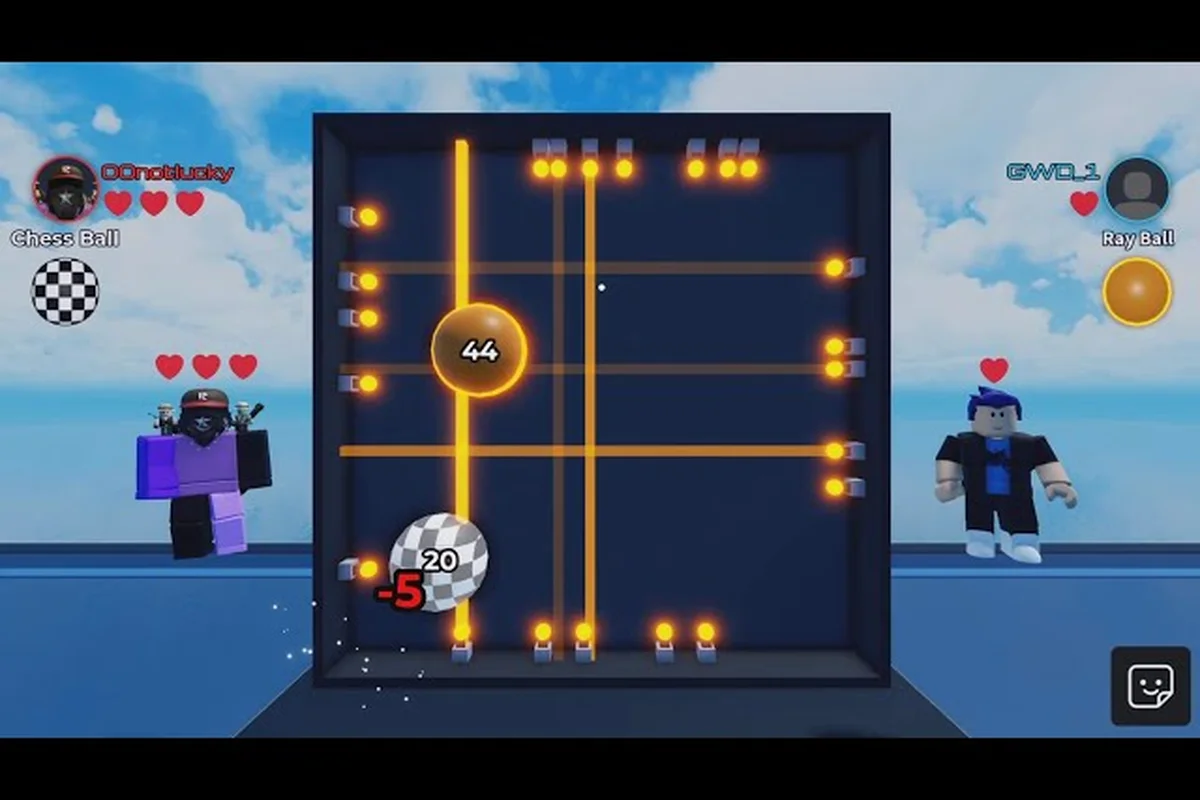
The Ball VS Ball trading sign is the single most misunderstood unlock in the entire arena, because the game never tells you it exists until you stumble onto another player waving one. According to the official Ball VS Ball Roblox page, the core loop is fighting other players, earning coins from wins, and then spending those coins in the shop to collect balls — but that loop does not include any built-in way to swap balls directly with another player. That missing piece is exactly what the trading sign enables, and once you know how it works, your entire progression speed changes because duplicates stop being dead weight and start being leverage. This guide breaks down the ball vs ball trading sign, how to actually activate it, and which balls to put on the table first.
What the Ball VS Ball Trading Sign Actually Is
The trading sign is a player-created item that visually signals "I am open to trades right now." When you hold it in the arena lobby, other players can see that you are willing to negotiate a swap instead of a fight, which is essential because the base game loop only lets you fight or reroll — there is no native trade menu. Community guides, including the breakdown by Clout Brothers on YouTube, consistently treat the sign as the gateway mechanic for any meaningful ball-to-ball swap.
Why the Sign Exists at All
Ball VS Ball does not ship with a trade system in the same way other Roblox simulators do. The developer, ATYS 3, built the game around a coin economy where wins feed the shop, and the shop is where new balls are purchased. The trading sign is the community workaround: a way to advertise, a way to find partners, and a way to mark yourself as a trusted swap target. Without the sign, you are relying on random chat messages in the lobby, which is how most scams in the game's scam prevention scene start.
How It Differs from the In-Game Shop
The shop sells balls at fixed coin prices that rotate daily across the Ball, Explosion, and Flyer families at Rare, Epic, and Legendary tiers, as confirmed by the store structure visible in the official developer product listings. The trading sign, by contrast, lets you bypass coins entirely and acquire balls through direct swaps. That makes it the only path to balls you missed during a shop rotation, or balls that other players are willing to part with at a discount compared to the coin price.
| Feature | In-Game Shop | Trading Sign |
|---|---|---|
| Currency | Coins (earned from wins) | Other balls of agreed value |
| Stock | Rotates daily, fixed tiers | Whatever the other player owns |
| Best for | Steady progression | Filling collection gaps fast |
| Risk | None | Scam risk if partner is unvetted |
| Speed | Slow, depends on win rate | Instant if both sides agree |
How to Unlock the Ball VS Ball Trading Sign
Unlocking the sign is not a single quest step — it is a chain of small prerequisites that the official description never spells out. Community testing across multiple guides points to three checkpoints you have to clear before the sign becomes usable in your inventory.
Step 1: Reach a Minimum Collection Threshold
You need to own enough distinct balls for any trade to make sense. A new account with only the default ball cannot trade because there is nothing of value on either side of the table. Most players in the community report that the practical threshold sits around 10 to 15 unique balls, which usually means clearing the first two or three shop rotations. Players who want a faster path should focus on the cheapest Rare drops first, because volume matters more than rarity at this stage.
Step 2: Join the Developer Group for Free Rewards
The ATYS 3 developer group had over 1.26 million members as of late September 2026, and the official game description explicitly tells players to join for free rewards. Group-exclusive balls are a frequent catalyst for trades, because they cannot be bought in the regular shop and only enter the ecosystem through swaps. Holding even one of these group balls gives you a tradeable asset that other players actively seek out, which is the practical entry point into the trading scene.
Step 3: Equip the Sign in the Lobby
Once you have the inventory depth and the group perks, the sign itself is equipped from your inventory in the pre-match lobby. The sign does not consume any coins or items when you hold it, but it does mark you as a trader for the duration of the lobby session. If a match starts and you do not unequip it, it simply despawns and you can re-equip it after the round. This timing detail matters because most sign-waving happens in the lobby, not during a match.
Ball VS Ball Trade Values: What Is Actually Worth Swapping
Trade values in Ball VS Ball are not posted anywhere official, which is why a value list and demand tracker becomes essential once you start negotiating. The community has converged on a rough tier system that mirrors the shop's Rare / Epic / Legendary structure but adds a separate axis for how many players want the ball.
The Three Trade Tiers
Most community-curated value lists break the trading pool into three rough tiers based on what the community reports from active trading sessions. S-Tier trades are balls that the developer has marked as limited or that have been vaulted from the rotation, and these command steep premiums. A-Tier trades are top-of-rotation Legendary and Epic balls that other players are actively trying to complete. B-Tier trades are solid Rare and common Epic balls that are easy to find but still useful for filling collection gaps.
| Tier | Typical Balls | Typical Asking Price | Trade Difficulty |
|---|---|---|---|
| S-Tier | Vaulted Legendary, group exclusives | 3+ Legendary equivalents | Hard to find partners |
| A-Tier | Current Legendary rotation | 1 Legendary for 1 Legendary | Moderate, active demand |
| B-Tier | Epic and Rare drops | 2-3 Epics for 1 Legendary | Easy, lots of offers |
Demand vs. Raw Rarity
A common mistake new traders make is assuming that rarity equals value, but community data shows the opposite is closer to the truth. A Rare ball from a popular family like Flyer can trade for more than a forgotten Legendary from a weak family, because the number of players who actively want it is higher. This is the single most important lesson in any ball vs ball trading guide, and it is the reason a trade calculator approach based on demand usually beats a raw rarity score.
Ball VS Ball Best Trades: Combos That Actually Work
The best trades are not about squeezing every last coin of value out of your partner — they are about repeatable swaps that both sides walk away from feeling like they won. Community reports and the breakdowns in the CHALLS beginner guide video point to a handful of swap patterns that work consistently.
The 2-for-1 Epic Trade
If you own multiple Epic balls from the same family and your partner is looking to complete that family, a 2-for-1 Epic for Legendary swap is the cleanest deal in the game. Both sides get something they wanted, and the value gap is small enough that almost no one walks away. This is the most common type of ball vs ball best trade because it does not require any rare inventory to set up.
The Family Completion Trade
Players who are one ball away from completing a family will often overpay in Epic terms to finish the set, because the in-game collection bonuses are significant. If you happen to hold the missing piece, you can usually request a Legendary plus a smaller Epic sweetener. The trade calculator logic here is simple: completion value is high, and the partner's urgency is real.
The Group-Exclusive Swap
Group-exclusive balls are the closest thing Ball VS Ball has to a hard currency, because they cannot be bought in the shop and the only way to acquire them is through the developer group or through a trade. Swapping one group-exclusive for another group-exclusive is a stable middle-ground trade that almost never gets scammed, because both sides understand the value. This is also the safest entry point for players who are nervous about scam prevention rules in their first few swaps.
| Trade Type | You Give | You Get | Best For |
|---|---|---|---|
| 2-for-1 Epic | 2 Epic same family | 1 Legendary | Epic-heavy inventory |
| Family Completion | The missing ball | 1 Legendary + 1 Epic | Holding the rare piece |
| Group-Exclusive | 1 group ball | 1 group ball | Safe first trades |
| Rotation Dump | Stacked duplicates | 1 Legendary | Cleaning out inventory |
Setting Up Your First Trade Safely
The first trade is always the most dangerous one, because you do not yet have a feel for the lobby or for which players are trustworthy. A few habits will protect you while you learn the ropes.
Verify Before You Swap
Always confirm the ball the other player is offering by asking them to re-equip it in the lobby so you can see it on their avatar. Verbal descriptions in chat are easy to fudge, and screenshot swaps are even easier to fake. The safest first trades are done in the lobby before a match, with both balls visible, and both players confirming the swap at the same time.
Avoid the "Double Trade" Trap
The most reported scam pattern in the community is the double trade, where one player offers two balls but only delivers one after the other side has already swapped. The only reliable defense is to perform both sides of the trade in the same lobby interaction, with both balls re-equipped right before the swap happens. Once you have done a few clean trades, you will start recognizing the players who operate in the trading scene regularly, and that network is the real long-term protection.
Recognising a Dead-End Trade
If a deal feels too good to be true, it almost always is. A player offering a Legendary for a single Rare is either brand new, mistaken about value, or running a scam. Walking away costs you nothing; accepting a bad trade can cost you a week of progression. The ball vs ball how to trade mindset is just as much about the trades you refuse as the ones you complete.
Common Mistakes New Traders Make
Even players who understand the basics still fall into a few predictable traps during their first week of trading. Naming them out loud is the fastest way to avoid them.
Overvaluing Duplicates
A duplicate Legendary feels valuable because you spent a lot of coins to get it, but if the family is already complete for you, its actual trade value is whatever the community says it is, not what you paid. Pricing duplicates at shop cost is the single most common reason a new trader cannot find a partner.
Ignoring the Rotation
The daily shop rotation matters even if you are not buying anything, because it sets the market price for the next 24 hours. If the shop is currently selling a Legendary at a low coin price, the trade value of that ball drops with it. Watching the rotation for a few days before you start trading is a small investment that pays off in better deal quality.
Trading Under Pressure
A partner who insists the trade has to happen right now, in the next 30 seconds, before the match starts, is almost always trying to rush you past the verification step. The fix is simple: every good trade can wait one match. If the partner will not wait, the trade is not worth doing.
Frequently Asked Questions
How do I get the ball vs ball trading sign in the first place?
The sign is unlocked once you reach a small collection threshold (around 10 to 15 unique balls) and join the ATYS 3 developer group for the free group-exclusive rewards. After that, the sign becomes available in your inventory and can be equipped in the lobby to advertise that you are open to swaps.
What is the best ball to trade away early on?
Duplicate Rare balls from a family you have already completed are the safest early trade fodder, because you do not need them and other players will swap small bundles of Epic balls to fill their own collection gaps. Holding your only Legendary until you understand the market is the safer play.
Is there a real ball vs ball trade calculator I can use?
There is no official calculator, but community-maintained value lists on Roblox profiles and Discord servers function as one. The most reliable method is to check what the daily shop charges for the same ball, add a small premium for rarity, and compare against recent completed trades that other players report in the trading scene.
Can I get scammed while using the trading sign?
Yes, and the scam prevention guide covers the most common patterns in detail. The short version is to always verify both balls are equipped in the lobby before the swap, never accept rushed deals, and stick to partners who have an established trading history.
Should I focus on trading or on winning matches first?
Early on, winning matches is the higher priority because coin income feeds the shop rotation, which feeds your collection depth, which is what makes you a viable trading partner in the first place. Once you have enough unique balls to actually swap, trading becomes a faster progression path than grinding coins, and that is the moment the trading sign starts paying for itself.